
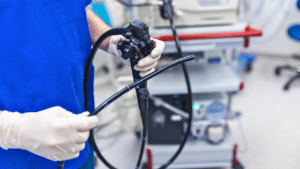
Patients across the country are raising concerns about severe infections linked to reusable Olympus endoscopes and duodenoscopes. These medical scopes are used in common procedures such as colonoscopies, upper endoscopies, bronchoscopies, urological procedures, and ERCP procedures involving the bile ducts and pancreas.
Lawsuits allege that certain reusable Olympus scopes were defectively designed because their complex parts may trap bacteria, organic material, and biofilm in areas that are extremely difficult—or physically impossible—to fully clean. Plaintiffs claim that contaminated scopes exposed patients to serious infections, including sepsis, organ failure, drug-resistant “superbug” infections, and, in some cases, death.
At Salenger, Sack, Kimmel & Bavaro, LLP, our attorneys are reviewing potential Olympus scope infection claims for patients and families who suffered serious complications after a scope procedure.
Free case review. No fee unless we recover compensation for you.
Olympus manufactures reusable medical scopes used by hospitals and surgical centers to examine and treat areas inside the body. These devices can include:
The central allegation in these lawsuits is that certain Olympus scopes contain small, intricate components that can be difficult to clean between patients. In particular, some duodenoscopes include an “elevator mechanism,” a moving part near the tip of the device that helps physicians guide surgical tools during procedures.
Plaintiffs allege that this elevator mechanism and other internal channels may contain microscopic crevices where bacteria can survive standard cleaning, disinfection, or sterilization. When the same scope is reused on another patient, hidden contaminants may be transferred into the body and cause a serious infection.
Lawsuits allege that certain Olympus reusable scopes were designed with complex internal channels, moving parts, seals, and crevices that made complete sterilization unreasonably difficult. Plaintiffs claim bacteria could remain inside the device even after hospitals followed the manufacturer’s reprocessing instructions.
Patients and families allege that Olympus failed to adequately warn hospitals, physicians, and the public about known infection risks associated with certain reusable scope designs.
Some claims argue that Olympus provided cleaning and reprocessing instructions that were not sufficient to eliminate bacteria from hard-to-reach areas of the device.
Olympus previously pleaded guilty to federal criminal charges involving the failure to file required FDA adverse event reports connected to serious infections involving duodenoscopes.
Olympus has faced FDA warning letters, recalls, advisory notices, and import alerts involving certain scopes, accessories, and reprocessing-related products. These regulatory actions have increased scrutiny of the company’s quality systems, reporting practices, and device safety controls.
If you or a loved one has experienced health complications due to the Olympus scope, don’t wait to seek legal help.
Contact Salenger, Sack, Kimmel & Bavaro today for a FREE consultation.
Call (800) 675-8556 or contact us online to get started.
Potential Olympus scope lawsuits may involve serious infections diagnosed shortly after a scope procedure, including:
Not every infection after a procedure means there is a lawsuit. These claims usually require medical records showing the timing of the procedure, the type of scope used, the organism identified, the treatment required, and whether other patients were exposed or infected.
You may qualify for a case review if:
Families may also have a potential wrongful death claim if a loved one died after developing a severe infection linked to an Olympus scope procedure.
Reusable Olympus scopes may be used in a wide range of diagnostic and surgical procedures, including:
Endoscopic retrograde cholangiopancreatography, or ERCP, is used to diagnose and treat conditions involving the bile ducts, gallbladder, liver, and pancreas. Duodenoscopes are commonly used in ERCP procedures and have been a major focus of infection-related safety concerns.
A colonoscopy uses a scope to examine the colon and rectum. While many colonoscopies are performed safely, lawsuits are investigating whether certain reusable scopes may expose patients to infection when contamination remains inside the device.
An upper endoscopy allows doctors to examine the esophagus, stomach, and upper small intestine. Patients who developed severe infections after an upper endoscopy may need their records reviewed.
A bronchoscopy uses a scope to examine the airways and lungs. Olympus bronchoscopes and related accessories have also been the subject of safety notices and regulatory scrutiny.
Certain Olympus reusable scopes and accessories may be used in procedures involving the urinary tract, bladder, kidneys, uterus, or reproductive organs.
Reusable medical scopes are designed to enter the body and then be cleaned for use on another patient. That process is known as reprocessing. It may include manual cleaning, brushing, flushing, high-level disinfection, sterilization, drying, and storage.
The problem alleged in these lawsuits is that some Olympus scopes may contain areas that are too narrow, complex, or hidden to reliably clean. Bacteria can form biofilm, a protective layer that allows microorganisms to survive on surfaces and resist ordinary disinfection.
Plaintiffs argue that when bacteria remain inside a scope after reprocessing, the next patient may be exposed to dangerous organisms during an otherwise routine medical procedure.
Useful evidence may include:
Patients often do not know what brand or model of scope was used. Our attorneys can review the available records and help determine whether an Olympus device may have been involved.
Depending on the facts, an Olympus scope infection lawsuit may seek compensation for:
The value of any claim depends on the severity of the infection, the medical proof, the timing of diagnosis, the device used, and the long-term harm suffered.
Deadlines vary by state and by type of claim. In New York, many injury claims are subject to strict statutes of limitations, and different deadlines may apply if the claim involves wrongful death, a hospital, a public entity, or delayed discovery of the injury.
Because contaminated scope cases often involve complex medical records and product identification issues, it is important to speak with an attorney as soon as possible.
Waiting too long may affect your ability to bring a claim.
Salenger, Sack, Kimmel & Bavaro, LLP represents injured patients and families in serious medical malpractice, product liability, wrongful death, and catastrophic injury cases.
Our firm understands the medical and legal complexity involved in infection-related claims. These cases often require careful review of procedure records, infectious disease records, hospital protocols, device tracking logs, and expert analysis.
When a medical device may have caused life-altering harm, patients deserve clear answers.
If you or a loved one developed a serious infection after a procedure involving an Olympus endoscope, duodenoscope, colonoscope, bronchoscope, or other reusable scope, you may have legal options.
Contact Salenger, Sack, Kimmel & Bavaro, LLP today for a free case review.
Call 800-675-8556 or complete our online form.
There is no fee unless we recover compensation for you.
The Olympus endoscope lawsuit involves claims that certain reusable Olympus scopes were defectively designed and could not be fully sterilized between patients. Plaintiffs allege that hidden bacteria inside the devices caused severe infections, sepsis, organ failure, and death.
A duodenoscope is a specialized endoscope used during ERCP procedures to diagnose and treat conditions involving the bile ducts, gallbladder, pancreas, and liver. Some duodenoscopes include an elevator mechanism that has been linked to cleaning and contamination concerns.
A contaminated scope may expose a patient to bacteria that can enter the bloodstream and cause sepsis. Sepsis is a life-threatening medical emergency that can lead to organ failure, ICU admission, and death.
Many claims involve infections that developed within days or weeks after the procedure. Some law firms are reviewing infections diagnosed within approximately 30 to 90 days, although the timing depends on the infection type and medical records.
Potential infection symptoms may include fever, chills, severe abdominal pain, weakness, confusion, shortness of breath, rapid heartbeat, worsening pain, nausea, vomiting, or signs of sepsis. Anyone experiencing these symptoms should seek immediate medical care.
No. Many patients do not know what device was used during their procedure. Medical records, hospital logs, and device tracking information may help determine whether an Olympus scope was involved.
The family may have a potential wrongful death claim if the infection can be linked to a contaminated scope or defective medical device. These cases require prompt investigation and careful review of medical records.
If you or a loved one suffered complications from a Olympus Scope Infection, you may have legal options.
Salenger, Sack, Kimmel & Bavaro, LLP offers free, confidential case evaluations and works on a contingency fee basis—you pay nothing unless compensation is recovered.
👉 Contact us today to see if you qualify for a Olympus Scope lawsuit.